



If anybody tells you affiliate marketing is dying because third-party cookies are obsolete (almost), they’d be lying. Sure, third-party tracking is being replaced by first-party consent-based monitoring, but that also means affiliate marketing is evolving. The disappearance of cookies doesn’t eliminate the demand for performance-based marketing. Instead, it forces a rethink of how value is created, measured, and rewarded.
Affiliates who learn to leverage first-party data, adopt server-to-server tracking, and build stronger relationships with both merchants and audiences won’t just survive but will find themselves in a stronger, more resilient ecosystem.
In this article, we will discuss the impact of 3rd party cookie disappearance of third-party cookies on affiliate marketing, examine business use cases across various industries, and develop a comprehensive strategy for affiliate marketers to implement by the end of the article. Let’s start with the basics – understanding the current state of cookies in the market and what led to their inevitable demise.
Third-party cookies and Affiliate Marketing: The Current State
Third-party cookies have been the backbone of affiliate marketing since its inception. They powered everything from tracking conversions across websites to ensuring affiliates received payment for the customers they referred. Then came the shifts – not just how people are tracked, but the whole online environment saw a seismic shift. Privacy regulations like GDPR and CCPA raised the stakes for advertisers on how they can track users. The end-users, on the other hand, became more aware and alert of how their personal information is being used. As browsers steadily chip away at cookie-based marketing, and Google is now firm on phasing out third-party cookies in Chrome, the final domino is falling.
For affiliate marketers, this shift isn’t just technical but existential. Cookies weren’t just a tracking mechanism; they were the invisible infrastructure that allowed affiliates to prove value, claim commissions, and personalize campaigns. No tracking cookies raises urgent questions: How will conversions be tracked across devices? What happens when attribution breaks down? And how can affiliates maintain profitability when the old system no longer works?
To answer these questions, we need to go back into the timeline of the cookie phase-out.
The Cookie Apocalypse: Timeline Recap
It is essential to understand that the end of third-party cookies isn’t an overnight event. It’s the culmination of years of incremental shifts that have already reshaped the way affiliate marketers operate.
The first cracks appeared when Safari’s Intelligent Tracking Prevention (ITP) and Firefox’s Enhanced Tracking Protection (ETP) began blocking third-party cookies by default as early as 2017–2019. Affiliates working in eCommerce, travel, and finance noticed their attribution windows shrinking and conversions going untracked on Apple and Mozilla browsers.
Google, which owns the most significant browser market share through Chrome, initially delayed its own phase-out several times—citing the need to give advertisers more time. But as of 2025, Google has confirmed a firm deprecation timeline, signaling that the era of cookie-based affiliate tracking is officially over.
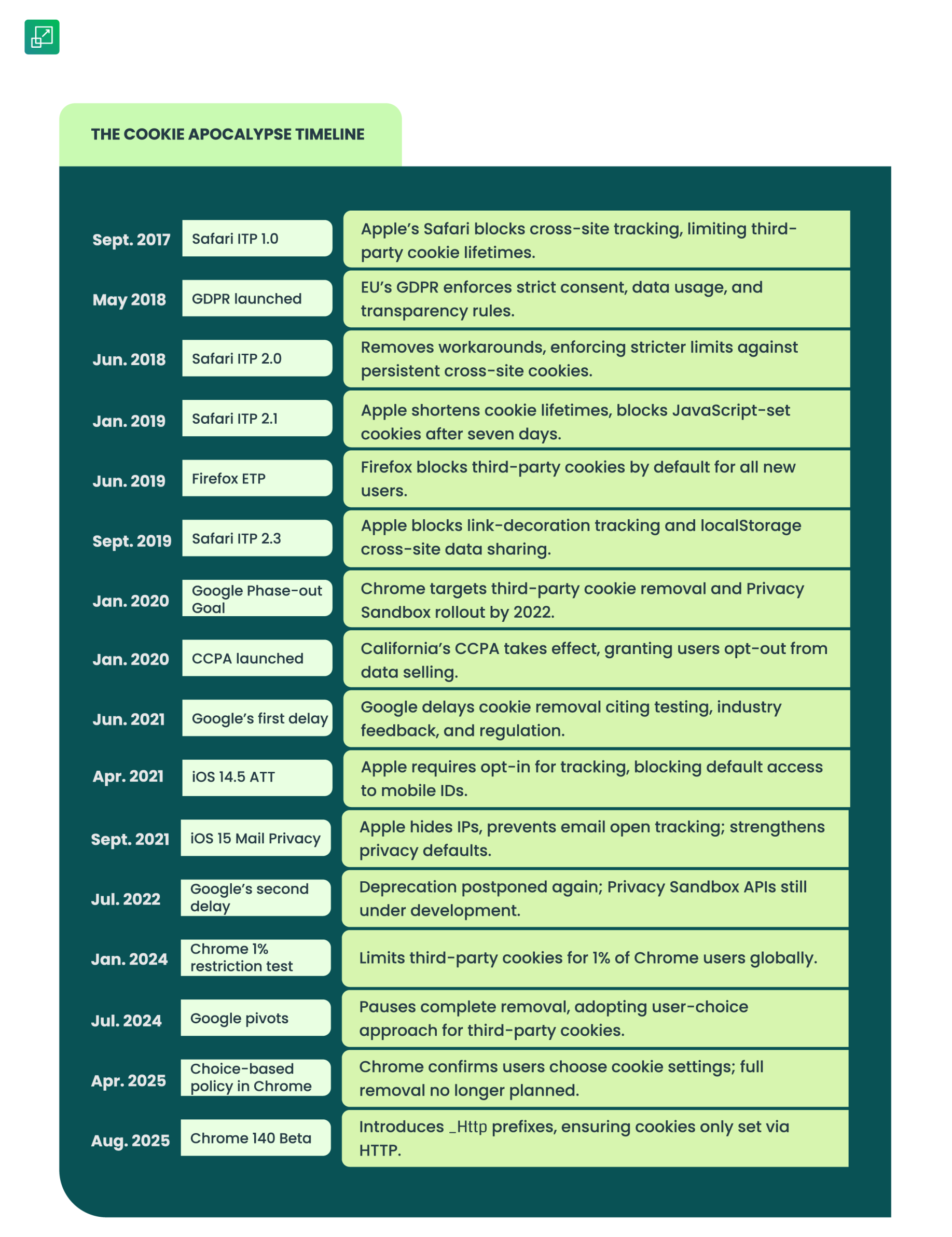
Although this event appears gradual, its onset had begun long before the timeline started. Cookies had already become unreliable before the official demise began. Ad blockers disrupted tracking scripts, affecting attribution visibility. Eventually, consent-driven laws made it easy for users to opt out of tracking altogether, an option that almost everyone embraced. Although some users did not actively opt out or block cookies, strict browser policies shortened cookie lifespans, reducing multi-touch visibility in longer purchase journeys.
For affiliates, this meant that the accuracy of their commissions was being chipped away year after year. Let’s take a hypothesis to understand the extent of the impact.
Let’s say you are a fashion affiliate who specializes in Instagram-driven campaigns. For years, you have relied on retargeting pixels to re-engage users who browsed a brand’s product page but didn’t purchase. That second or third touchpoint, often powered by a cookie, was what converted casual browsers into buyers. However, by 2022, Safari and Firefox had already implemented browser tracking restrictions. As a result, ROI started to slide. Add to that, a growing number of shoppers have started declining cookies on Chrome through consent banners. Suddenly, a reliable retargeting model started crumbling down, leading to very few conversions and more lost attribution.
Clearly, the decline of cookies’ reliability has been gradual, but the impact on affiliate revenue has been steady and significant. The affiliate industry has already transitioned into its “disruption” phase.
Challenges Affiliate Marketers Face in Cookieless World
Lack of cookies also means affiliates have to rewire the very foundation of how to prove value and get compensated. This shift has raised a few roadblocks that directly impact revenue, relationship with merchants, and long-term growth of affiliates.
1. Tracking disruption
Cookies once allowed affiliates to follow users across multiple sessions, devices, and websites, enabling a relatively clear view of the buyer journey. Without them, attribution windows are shrinking dramatically. A click that once carried a 30-day tracking life may now expire within hours, leaving affiliates unable to capture delayed conversions. Cross-device journeys, such as when a user clicks on a mobile ad but makes a purchase later on a desktop, are also increasingly invisible. Affiliates lose visibility into the very touchpoints that often make or break commissions.
2. Revenue leakage
The breakdown in tracking directly translates into lost income. Merchants now have more opportunities to dispute or deny commissions, citing “lack of attribution data” as evidence. For affiliates, this means conversions they rightfully influenced may no longer be credited to them. In industries with longer buying cycles, such as travel or high-value retail, the risk of revenue leakage compounds. Affiliates not only lose income but also bargaining power in negotiating fair terms with advertisers.
3. Data asymmetry
One of the most significant challenges is the growing imbalance in data ownership. Platforms like Google, Meta, and Amazon continue to track and measure user behavior within their ecosystem. Affiliates, on the other hand, lose access to granular insights once enabled by cookies. This asymmetry creates a dependency problem – Affiliates rely on the very platform that limits their visibility, while those same platforms push their own in-house affiliate and partner programs.
In a nutshell, affiliates are navigating a market where attribution is less reliable, revenue is harder to secure, and data is increasingly centralized in the hands of a few dominant players. In many ways, this shift feels more like a power shift than an evolution.
However, not everything is as bleak as it looks. While the power dynamics will always be a part of the advertising industry, affiliate marketers are looking at new affiliate models built with the latest toolkit – the one that has replaced cookies. Let’s understand what it is before exploring the new marketing models that can work.
The New Toolkit for Affiliate Marketers
Yes, third-party cookies are dead. But that isn’t the end of performance marketing. Affiliate marketers need to explore the new toolkit that advertisers and platforms are leaning on to restore trust, accuracy, and resilience in attribution. This includes:
- First-party data strategies
- Server-to-server (S2S) tracking
- Universal IDs and Privacy Sandbox
- Contextual targeting revival
-> Download free ebook: Boost Ad ROI with First-party data and Server-side Signals
Together, these tools form a new foundation for affiliate marketing. They don’t replicate cookies exactly, but they offer alternatives that are in many ways stronger, rooted in transparency, trust, and direct value exchange.
1. First-party data strategies
The most significant shift is ownership of data. Unlike third-party cookies, first-party data is consent-driven and collected directly from the user through newsletters, gated content, loyalty programs, or app interactions. For affiliates, this means prioritizing direct relationships with audiences rather than relying on intermediaries.
Example: A SaaS affiliate may capture leads through an email opt-in for a free resource. Instead of relying on cookies to track clicks across domains, referral codes within emails directly connect sign-ups to the affiliate, ensuring attribution while building a reusable audience asset.
But not all solutions depend on affiliates collecting data themselves. For direct tracking between partners, a more technical but increasingly reliable approach is gaining ground.
2. Server-to-Server (S2S) tracking
Server-to-server tracking bypasses the browser entirely. Instead of dropping a cookie on a user’s device, merchants and affiliate networks exchange tracking data directly between their servers. This not only sidesteps browser restrictions but also reduces the risk of fraud.
Example: In the gaming industry, affiliates driving app downloads often use S2S integrations with networks like Adjust or AppsFlyer. The install event is verified server-side, ensuring commissions are attributed correctly without reliance on cookies.
While S2S improves reliability, it doesn’t solve the challenge of reaching users in the first place. That’s where industry-wide IDs and emerging frameworks come into play.
3. Universal IDs and Privacy Sandbox
Google’s Privacy Sandbox introduces APIs like Topics, designed to serve interest-based ads without revealing personal data. Similarly, Unified ID 2.0 (UID2) uses anonymized email logins as a cross-platform identifier. Adoption, however, is uneven. Large ad-tech players are experimenting, but affiliates remain cautious—concerned that regulatory scrutiny could eventually target these identifiers as well.
Example: A retail affiliate network piloting UID2 can still segment users based on anonymized profiles, offering some of the personalization cookies once allowed.
But while Universal IDs are still in development, a more classic method of targeting has quietly been staging a comeback.
4. Contextual targeting revival
Before cookies, advertisers leaned heavily on contextual targeting: serving ads based on the content of the page, not the behavior of the user. In a cookieless era, this method is regaining traction. For affiliates, it means aligning offers with high-quality, topic-relevant content rather than relying solely on behavioral data.
Example: A personal finance blog promoting credit card offers doesn’t need cookies to know its readers are financially motivated. By embedding affiliate links within well-optimized content, the publisher achieves conversions through relevance rather than retargeting.
The cookieless toolkit sets the foundation, but tools alone don’t guarantee success. The next step is to tie the above information to affiliate models that actually work.
Affiliate Models You Must Adapt Now
Affiliates must rethink how they operate. From new business models to new-age revenue strategies and engagement tactics, this is how modern-day affiliate marketing looks like in practice.
1. Multi-touch or Probabilistic Attribution
Instead of crediting the “last click,” multi-touch attribution spreads credit across multiple touchpoints. Probabilistic models use patterns and historical data to infer which affiliate touchpoints influenced the final conversion.
Why it works today:
Modern customer journeys are fragmented across devices, platforms, and channels. Affiliates that can prove influence across this path strengthen their bargaining power with merchants.
Pros:
- Captures long and complex buyer journeys.
- Increases fairness in commission distribution.
- Reduces disputes with merchants over “untracked” conversions.
Cons:
- Requires sophisticated tech (CRM integration, attribution platforms).
- It may not be feasible for minor affiliates without data access.
Requirements:
- Merchant collaboration for CRM or analytics integration.
- Affiliate networks willing to credit assisted conversions.
Example:
HubSpot’s affiliate program ties referrals directly into its CRM system with a 90-day attribution window. Affiliates get recognition even if a lead converts weeks later, proving influence beyond the last click.

In an era where buyer journeys span devices, channels, and delayed cycles, affiliate marketers benefit from attribution systems that account for nuanced, multi-step paths to purchase. Hubspot’s program offers:
- Extended Cookie Window: HubSpot provides a generous 180-day cookie window, far longer than the typical 30 days. This prolonged window increases the chance that affiliates receive credit for conversions that occur long after the initial referral.
- CRM-Driven Reporting & Analytics: HubSpot integrates referral data directly with its CRM. Affiliates receive “highly customizable performance reports” that track leads, deals, and recurring revenue derived from their links. This transparency ensures affiliates can trace their influence beyond the first click.
- Attribution Integration Tools: HubSpot’s broader platform supports multi-touch attribution via custom reporting tools and ecosystem integrations, such as:
- Native multi-touch attribution: Within HubSpot’s reporting, affiliates and merchants can analyze first interaction, deal creation, and closed-won stages, allowing for breakdowns across multiple touchpoints through custom reports.
- Third-party attribution integrations: Tools like Attribution App or AttributionIQ sync ad spend, lead data, and revenue against marketing touches, creating detailed pipelines and cohort-level ROI reports.
- Recurrent Commission Structure: HubSpot offers 30% recurring commissions for up to one year, aligning long-term value with attribution so affiliates benefit from users they initially influenced, even if the conversion happened well after the click.
In essence, HubSpot empowers affiliates to be recognized for more than a fleeting click. They’re credited across the whole lifecycle journey.
2. Community-Driven Affiliate Marketing
Affiliates will need to become audience owners instead of traffic brokers. That means building spaces, whether through newsletters, YouTube channels, podcasts, or online communities. These are the spaces where people will come back for your content, trust your recommendations, and engage directly with you. Instead of sending anonymous clicks to merchants, your role will evolve into nurturing a loyal audience that sees you as a trusted voice.
Why it works today:
Cookies may disappear, but trust doesn’t. When you own the audience relationship, you control the channels (email lists, private groups, communities). You are no longer dependent on browsers or ad-tech platforms. This gives you resilience against tracking changes and opens up opportunities for recurring engagement.
Pros:
- Stronger long-term relationships with your audience.
- Direct communication channels that bypass browser restrictions.
- Opportunities to layer multiple monetization streams (affiliate, sponsorships, memberships).
Cons:
- Building and nurturing a community takes significant time and consistency.
- Requires ongoing content creation and engagement to keep audiences active.
Requirements:
- A clear niche or area of expertise where you can build authority.
- Platforms to host your community (email, Discord, Telegram, or dedicated membership tools).
- Content strategy that delivers value consistently.
Example:
Pat Flynn’s Smart Passive Income (SPI) is an interesting case study here. Flynn doesn’t just share affiliate links but builds trust through podcasts, courses, and an engaged community of entrepreneurs. When he recommends a tool like ConvertKit, his audience responds because they’ve built a relationship with him, not because a cookie tracked their behavior.

Community-driven models align with broader consumer behavior trends. Audiences trust individuals and niche experts far more than faceless ads. By investing in community, you future-proof your affiliate strategy, reduce dependency on volatile tracking methods, and create monetization opportunities that extend well beyond affiliate commissions.
3. First-Party Data Partnerships with Merchants
As third-party cookies vanish, the most reliable signals will come directly from the merchant’s first-party data, i.e., their CRM, purchase history, and logged-in customer activity. Affiliates who want to thrive in this new landscape will need to form deeper partnerships with merchants, integrating more closely into their systems instead of just driving clicks. This shifts your role from a surface-level promoter to a data-driven partner who helps merchants acquire and retain customers.
Why it works today:
First-party data is not only privacy-compliant but also highly accurate. When merchants track user activity on their own sites, attribution becomes far more reliable. By plugging into these systems (via APIs, dashboards, or direct reporting), affiliates gain better visibility, fewer disputes, and more substantial proof of value.
Pros:
- More accurate tracking and attribution, even without cookies.
- Better alignment with merchants → stronger trust and long-term partnerships.
- Potential to negotiate higher commissions by demonstrating real value through data analysis.
Cons:
- Requires closer technical and operational integration with merchants.
- Smaller affiliates may find it harder to negotiate access to such data.
- Risk of dependency on specific merchant relationships.
Requirements:
- A willingness to move beyond “traffic sending” into measurable business impact.
- Technical capability (or platforms/tools) to sync with merchant APIs, affiliate dashboards, or server-side tracking.
- Fostering strong relationships with merchants to gain access and trust.
Example:
Amazon Associates demonstrates this model at scale. While Amazon limits transparency to affiliates, it relies almost entirely on its own first-party data to track conversions across devices and user sessions. Affiliates benefit because Amazon can reliably attribute sales even if the customer delays their purchase, provided they remain within the attribution window.

On the B2B side, Shopify’s Affiliate Program takes this further: affiliates get detailed dashboards powered by Shopify’s own merchant CRM data. This allows affiliates to see which signups converted into paying merchants, removing ambiguity around attribution.

By tapping into first-party systems, affiliates insulate themselves from browser-level tracking restrictions. It also elevates their role: instead of debating over lost clicks, affiliates can show merchants the actual lifetime value of customers they influence. This not only protects commissions but can also unlock higher payouts and exclusive terms.
4. Hybrid Monetization Model
In a cookieless world, affiliates can no longer rely on a single revenue stream. Instead, the smart play is to adopt a hybrid monetization strategy where you blend affiliate links with complementary models like sponsorships, memberships, digital products, or consulting services. This approach ensures that even if attribution falters, you’re not left with a revenue gap.
Why it works today:
User trust and audience attention are now your most valuable assets. By diversifying how you monetize that attention, you create multiple safety nets. If an affiliate program cuts commissions or tracking becomes patchy, your income doesn’t collapse because you’ve spread your risk across channels.
Pros:
- Reduces dependence on cookie-driven affiliate programs.
- Multiple revenue streams strengthen overall business resilience.
- Unlocks new opportunities to monetize different segments of your audience (e.g., high-intent buyers vs. loyal community members).
Cons:
- More complex to manage multiple income models.
- Requires careful balance so your audience doesn’t feel “over-monetized.”
- Some streams (like courses or memberships) demand upfront time and content investment.
Requirements:
- A clear understanding of your audience’s needs and willingness to pay.
- The ability to test different revenue streams (ads, affiliate, digital products, sponsorships).
- Transparent communication with your community to maintain trust while monetizing.
Example:
Wirecutter (by The New York Times) is a classic affiliate-first site, but it’s also layered with subscriptions and brand sponsorships. This hybrid model means they don’t rely only on affiliate commissions; instead, they’ve diversified into multiple revenue channels, giving them long-term stability.

Hybrid monetization ensures that you’re not at the mercy of affiliate networks alone. You’re building a sustainable business where affiliate income is one part of a broader strategy. This positions you not as a vulnerable middleman, but as a creator-entrepreneur with multiple ways to monetize the trust you’ve built with your audience.
How to Choose the Right Model?
| Question to Ask | If Yes → | If No → | Suggested Model(s) |
|---|---|---|---|
| Do you already have a loyal following or engaged community? | Leverage that audience with Community-Driven Affiliate Marketing | Focus on building authority and merchant ties | Community-Driven / First-Party Partnerships |
| Do you have strong ties with merchants or the ability to negotiate deeper integrations? | Use First-Party Data Partnerships for reliable attribution | Rely on affiliate programs/platforms that offer multi-touch or modeled tracking | First-Party Partnerships / Multi-Touch Attribution |
| Is your niche high-ticket or long sales cycle (SaaS, finance, B2B)? | You need credit across the funnel → Multi-Touch Attribution | Short-cycle/lifestyle products perform better via direct audience influence | Multi-Touch Attribution / Community-Driven |
| Do you depend heavily on a single affiliate program for income? | You’re at risk → diversify with Hybrid Monetization | Keep layering multiple models to stay resilient | Hybrid Monetization + Any of the Above |
| Is your content consumer-focused (lifestyle, fashion, fitness)? | Prioritize trust + engagement → Community-Driven + Hybrid | Focus on data-backed attribution with merchants | Community-Driven / Hybrid Monetization |
Now that you know what attribution models might work for you, you must also consider the risks and limitations of these models.
Risks & Limitations of First-party Affiliate Programs
While the new toolkit like multi-touch attribution, community-driven growth, first-party partnerships, and hybrid monetization offers clear pathways forward, it’s not without trade-offs. Affiliates stepping into this new era must be aware of the challenges that come with it:
-
Increased dependency on merchant infrastructure
Server-to-server (S2S) tracking and API-based attribution reduce uncertainty but also put affiliates at the mercy of merchant systems. If a program lacks transparency, affiliates may find themselves disputing commissions without sufficient leverage. -
Regulatory uncertainty
Universal IDs and other cookie replacements are not immune to privacy laws. Affiliates who rely solely on technical fixes risk being caught off-guard if regulators clamp down, much like they did with cookies. -
Higher barrier to entry
Large affiliates with tech teams can adapt quickly; small or solo affiliates may find integrations, data pipelines, and advanced attribution models daunting. For them, success will require niching down and leaning heavily into community-driven trust.
Each model shines under certain conditions, but none are bulletproof. Affiliates must weigh the benefits against these risks, choosing an approach that balances opportunity with sustainability.
The Affiliate Marketing Playbook in a Cookieless World
The phase-out of third-party cookies doesn’t spell the end of affiliate marketing but enforces a rewrite. The new playbook looks less like cookie chasing and more like relationship building. Affiliates who thrive will adopt mindsets and practices that align with long-term trust and transparent value creation:
-
From traffic brokers to authority builders
Instead of chasing quick clicks, affiliates must become trusted voices with an audience that follows them across platforms. Content and credibility will be the new attribution engine. -
Expect consolidation
Larger affiliates and networks with strong data stacks will capture a bigger share of the market. Smaller affiliates won’t disappear but they’ll need to niche down, focus on hyper-specific audiences, and build deeper merchant ties. -
Trust as the ultimate currency
Transparency in how you recommend products, disclose partnerships, and safeguard data will be as important as your conversion rates. The affiliates who win will be the ones their audiences genuinely believe in.
Key takeaways:
Affiliate marketing isn’t being erased; it’s being rewritten. The winners will be those who:
- Own their audience relationships.
- Partner closely with merchants to leverage first-party data.
- Embrace smarter attribution models that reflect modern buyer journeys.
- Diversify their monetization beyond just affiliate links.
Cookies may disappear, but affiliate marketing has always been more than pixels. It’s about influence, credibility, and delivering value at the right time.
Concluding Thoughts
Affiliate marketing has always been about connecting buyers with solutions through trusted voices. What’s changing isn’t the core value, but the mechanics of attribution and monetization.
Yes, tracking is harder. Yes, commissions may face new disputes. But affiliates now have a chance to evolve into something stronger: audience owners, strategic partners, and diversified entrepreneurs who aren’t at the mercy of one fragile tracking method.
The playbook for the future is already clear:
- Adopt attribution models that reflect how people actually buy today.
- Build and nurture communities where your recommendations carry weight.
- Partner with merchants for deeper, data-backed collaborations.
- Diversify revenue streams so you’re not vulnerable to any single program.
The next era of affiliate marketing will be leaner, smarter, and built on trust. In other words, 3rd party cookies are crumbling, but opportunity is not. The question is—are you ready to evolve with it?
Subscribe to the Scaletrix Blog to keep learning about first-party tracking, server-side tagging, and consent-based marketing analytics.