


First-party data is beyond being just a hygiene factor. Brands that are truly winning are those that have elevated their own data. They treat first-party data not as a compliance burden but as a strategic backbone of performance marketing. They are not just collecting data; they are weaponizing it. How? By tying performance marketing to first-party data tracking.
Also read: Lower CAC, Higher ROAS: Unlocking the Advantages of First-party Data
Before we dive into the what and how, let’s do a quick recap of why first-party data is at the center of performance marketing.
Third-party cookies are history. You have already started implementing server-side tagging and first-party data collection. Yet, sometimes it still feels like you are running in circles.
Well, you are not alone. When third-party cookies went obsolete, we automatically shifted to first-party tracking. We got the competitive edge because now we are talking about genuine customer data that can drive value. But there are other fragments that we seldom talk about. The performance landscape is under intense pressure due to the consistently rising CAC. User journeys are now fragmented across many channels. This fragmentation drastically cuts visibility across the funnel. Automated ad platforms demand inputs that are highly precise.
Whether it’s Sephora transforming its loyalty-driven data into a powerful engine for unlocking high-lifetime-value audience targeting or Starbucks seamlessly connecting Point-of-Sale (POS) data with mobile app activity to achieve dynamic, hyper-optimized offer delivery, these brands have stopped surviving and started winning. In this article, we will trace how first-party data is enabling and driving performance marketing for small and large businesses alike.
Why Performance Marketing Needs First-Party Data?
If you thought shifting to first-party data strategies is the end-game, you have just rubbed teh tip of an iceberg. Treating it as a technical fix is more like ignoring the blazing facts point-blank.
Performance marketing is a results-driven strategy where advertisers pay only when a specific, measurable outcome occurs (e.g., a click, lead, or sale). Its core value is quantifiable ROI and real-time optimization.
It critically needs first-party data for two major reasons:
- Fueling AI: Ad platforms (Meta, Google) and search engines are now dominated by sophisticated AI algorithms. These “black boxes” need detailed and unique first-party signals (like customer lifetime value or lead quality) to make accurate predictions, improve performance, and create highly personalized experiences, which boosts efficiency and return on investment (ROI).
- Keeping Track: As third-party data becomes less useful, first-party data is the only reliable source for understanding scattered customer journeys and ensuring the accurate targeting needed to thrive in a situation where AI-driven search results lower organic traffic.
For example, automated campaigns like Meta Advantage+ only perform at peak efficiency when they receive sophisticated, high-signal datasets. These datasets must go beyond simple purchase events to include indicators like purchase frequency, margin-adjusted LTV, and churn risk. These are the signals that allow the algorithm to accurately model and prioritize the highest-value users for your business.
First-party data is also crucial because of the increasing CAC.
The relentless rise in Customer Acquisition Costs (CAC) means that simply increasing your budget is an unsustainable path to growth. Competitive advantage must be driven by efficiency and the elimination of wasted spend.
Also read: Boost Ad ROI with First-party data and Server-side Tagging
First-party data is the instrument of precision. Leveraging proprietary first-party insights allows you to:
- Reduce waste by automatically excluding low-value, high-churn users from retargeting pools.
- Identify and prioritize high-intent, high-margin cohorts for budget allocation.
- Optimize bidding strategies based on predictive CLV rather than simple conversion volume.
This moves media buying from a volume game to a value game.
Shrinking Browser-Based Tracking Makes First-Party Infrastructure a Performance Multiplier
While the move away from third-party cookies started as a privacy and compliance exercise, the resulting need for robust first-party infrastructure has become a direct performance multiplier.
When you own the data infrastructure (via server-side tagging, Customer Data Platforms, etc.):
- You gain unmatched reliability in data collection, bypassing browser-level restrictions.
- You can create custom, complex audience segments that are impossible to model accurately using simplified client-side data.
Simply put, those who have invested in their first-party infrastructure are not just complying with privacy standards; they are building the most reliable, high-fidelity source of truth for their marketing algorithms, yielding demonstrably better ROI.
How? By implementing the new growth engine, aka the data-driven performance marketing.
Data-Driven Performance Marketing
Shifting to first-party data is not about building a bigger database; it’s about architecting a growth engine that uses data to drive performance execution. This demands moving beyond simple collection to the strategic generation and activation of high-fidelity customer signals.
Building Actionable Customer Signals (Not Just Storing Data)
The critical performance lift comes from transforming raw, messy data into clean, performance-grade signals. This process involves enriching user activity with business context to create segments that instantly inform bidding and targeting strategies.
Key actionable signals include:
- High-Value Purchasers: Not just buyers, but those with the highest average order value (AOV) or shortest repurchase cycle.
- Predicted LTV Cohorts: Using historical behavior to model which new users are most likely to become highly valuable customers.
- Churn-Risk Segments: Identifying customers showing early signs of dormancy for targeted win-back campaigns.
- Replenishment Cycles: Pinpointing the exact window for automated, high-intent re-engagement offers.
The power is unleashed when these proprietary signals are matched and synced consistently across ad platforms. This allows the algorithms to optimize for the metrics that truly drive your business, not just simple clicks or generic conversions.
For instance, the global athletic footwear and apparel brand, Nike, demonstrates this integration perfectly.
It doesn’t just use commerce data. Nike blends behavioral data from the Nike Training Club (NTC) app (engagement frequency, preferred workout styles) with their purchase history. Then they create sophisticated, predictive high-value segments. This allows Nike to execute highly efficient cross-sell campaigns, such as promoting specialized running gear to an NTC user who just completed a demanding training regimen. As a result, it dramatically improves cross-selling efficiency.
Similarly, Nike by You customization platform acts as a continuous, high-fidelity source of preference data. Every selection a user makes—every chosen material, color, and personalized text—is an explicit, first-party signal of taste and intent. This data not only powers highly personalized marketing offers but also directly guides future product development and merchandising choices, creating a positive, data-driven cycle of matching products to market needs.
Real-Time Activation Across Media Platforms
First-party data infrastructure must enable real-time activation. This means setting up strong server-to-server links—like Meta’s Conversions API (CAPI), Google’s Enhanced Conversions (EC), and different offline conversion APIs—to quickly send your own data back to the platforms
This server-side connection dramatically improves two critical aspects of performance:
- Algorithmic Learning: By providing platforms with the most accurate, reliable conversion and value data, the algorithms can learn faster and more accurately, optimizing bids for actual ROI.
- Attribution Accuracy: Server-side matching closes the gap created by ad blockers and privacy settings, giving you a clearer view of the customer journey.
This is where match rate—the percentage of customer records you can successfully link to a platform’s user ID—becomes a critical competitive advantage. A higher match rate translates directly into a larger, more reliable data pool for optimization.
For instance, the Indian fashion brand, W for Woman achieved an 80%+ match rate. The fashion brand saw its match rate for custom audiences on Meta drop to a mere 25%. They shifted strategies and implemented a robust first-party data collection strategy while integrating server-side syncing. The brand was able to boost its match rate to over 80%. This massive increase in high-quality signals allowed Meta’s algorithms to optimize campaigns far more effectively, leading to a 35% reduction in CAC and a 2x increase in return on ad spend (ROAS).
The strategic commitment to building a first-party data architecture is only the foundational step. The ultimate question is: Where does this investment pay off?
Competitive Advantage of First-Party Data in Performance Marketing
The true competitive advantage of first-party data is realized at the campaign execution level. Marketers can execute with a precision that generic, pixel-based strategies simply cannot match, resulting in disproportionately higher efficiency and ROI. Below are the two major competitive advantages of using first-party data in performance marketing.
1. Precise Targeting and Lookalike Audiences
In a performance world dominated by increasingly vague, interest-based targeting, your proprietary data is the ultimate segmentation tool. The goal is to move beyond generic, pixel-based audiences (like “Past 90-day Website Visitors”) to create deeply valuable, actionable segments.
This means leveraging your CRM data, LTV predictions, and churn insights to inject quality into your ad platform targeting:
- Precision Targeting: Using first-party data, you can build audiences focused only on high-margin customers or those who converted after interacting with a specific piece of high-value content.
- Better Exclusions: By identifying and excluding recent purchasers or users identified as high churn-risk, you drastically reduce media wastage and prevent irrelevant ad spend.
- High-Fidelity Lookalikes: Ad platform AI excels at modeling new users based on robust seed audiences. When you seed Lookalikes with a segment of your top 5% LTV customers (instead of a simple “All Purchasers” list), the algorithm recruits customers who are far more likely to generate long-term value.
For instance, Sephora’s industry-leading Beauty Insider loyalty program is the strategic backbone of its performance marketing. Instead of using generic purchase data, Sephora segments its members based on spending tiers (Insider, VIB, Rouge).

By feeding the high-value Rouge and VIB member lists into platforms like Meta and Google as seed audiences, they create high-performing lookalike campaigns. This approach ensures their ad spend is primarily focused on attracting new customers who share the behavioral and purchasing characteristics of their most valuable, high-retention client base, dramatically boosting campaign efficiency and CLV.
2. Personalization at Scale
In the absence of reliable third-party cookies, first-party data is the only reliable way to achieve personalization at scale. This moves performance marketing beyond simple retargeting to serving creatives and offers that are explicitly aware of the customer’s unique stage in their lifecycle, purchase frequency, and recency of last interaction.
Achieving this level of precision requires merging data silos, such as connecting onsite browsing behavior, email engagement metrics, and historical purchase data. This unified view allows you to:
- Tailor Creative: A user who last bought a product 10 days ago sees a different ad than one who purchased 90 days ago.
- Optimize Offers: Serving a first-time offer to a new lead, but a loyalty-tier offer to a repeat buyer.
- Highly Dynamic Audience Refresh: The ability to refresh these personalized segments in near real-time drastically improves ROAS by ensuring ad dollars are always spent against the most current customer intent.
For example, Starbucks excels at this by seamlessly integrating Point-of-Sale (POS) data from in-store purchases with its mobile app usage and Starbucks Rewards activity. This unified first-party view allows them to optimize offers at a highly granular level.
For instance, if a customer typically buys a latte every morning but hasn’t purchased one in three days (recency signal), they might receive a personalized, high-value push notification or paid ad offer for a free pastry with their next purchase (offer optimization). By dynamically linking loyalty status and purchase frequency, Starbucks delivers journey-aware performance marketing that drives immediate store visits and repeat purchases.
3. Measurement, Attribution, and True Optimization
The move to server-side measurement (CAPI, Enhanced Conversions) may seem like a technical challenge, but its true benefit is the clear attribution it provides, which helps make budgets more efficient. When data avoids browser limitations, the accuracy of conversion reporting improves dramatically.
Also read: Why Sentiment Signals are the Missing Piece in Your Attribution Stack?
This clarity allows advertisers to use granular first-party signals to compel ad platforms to optimize toward true business outcomes, not proxy metrics. Instead of simply optimizing for a “conversion,” campaigns can focus on signals like:
- Subscription Quality (e.g., predicted churn risk, payment plan).
- Repurchase Probability.
- Margin-Adjusted Purchase Value (instead of raw revenue).
For example, The Economist recognized that optimizing solely for low-cost signups resulted in a high volume of quick-churning users. By implementing robust server-side integrations, they began feeding subscription-quality data (indicators of long-term retention potential) back into platforms like Meta.
This allowed the algorithms to change their focus from getting a lot of cheap signups to finding users who are more likely to stay long-term and become valuable subscribers, using performance marketing for lasting growth.
4. First-Party Data Acts as a Long-Term Retention Engine
Performance marketing’s core challenge is dependency on increasing Customer Acquisition Cost (CAC). First-party data strategically addresses this by becoming the engine of retention. Retention is the new acquisition, reducing dependence on ever-increasing ad spend.
By analyzing purchase frequency, recent activity, and browsing patterns, brands can build predictive models that determine the next best action for a customer. This moves retention from reactive customer service to proactive performance marketing.
For example, we again have Starbucks’ success that hinges on its ability to drive repeat visits. The Starbucks Rewards program is a masterclass in using first-party data to power retention. By analyzing app usage, geolocation, and historical purchase patterns (e.g., drinks, time of day), they deliver hyper-personalized promotions and challenges.
Source: Youtube Channel owned by Mitchele Riderelli
This smart use of data to create personalized experiences leads to loyalty members visiting more often and having a much higher Customer Lifetime Value (CLV) than those who are not members.
5. Omnichannel Activation: Offline + Online = Performance Edge
The biggest benefit of first-party data is that it helps connect what customers do in stores with their online activities, allowing for a seamless experience across all channels. Your owned data becomes the universal identifier that connects physical store visits to digital ad exposure.
This integration creates powerful performance loops:
- POS Data to Digital Retargeting: Using in-store purchase data to target those same customers with digital cross-sell ads online.
- Loyalty Segmentation to Ads: Activating detailed loyalty segments (e.g., high-LTV, last purchase in store) for personalized ads across CTV, social, and search.
- Retail Media: Retailers leverage their deep first-party shopper data—the most valuable form of data available—to provide advertisers with a guaranteed performance edge.
For example, Walmart Connect, the retailer’s media arm, exemplifies this. They utilize their massive volume of in-store and online shopper data (first-party data on actual purchase history, frequency, and basket size) to allow advertisers to segment audiences and measure campaign effectiveness with unparalleled precision. This unique access to the complete shopper journey significantly boosts advertiser Return on Ad Spend (ROAS) compared to platforms relying solely on inferred online data.
We have already established the why and the where of first-party data advantage. The final crucial step is providing a clear, actionable how.
How to Turn First-party Data into Performance Power: A Practical Framework
You already know that the transition to a first-party-driven performance model is not a quick fix. It’s a fundamental overhaul of your marketing infrastructure. This transition requires moving your team’s focus from tracking technology to the continuous creation and refinement of high-fidelity customer signals. This commitment is the defining difference between brands that are merely compliant and those that are competitively dominant.
Below is a blueprint that outlines the immediate steps required to transition your first-party data strategy from a compliance necessity to a performance driver. This framework is more like an iterative loop than a linear project and is designed to maximize the performance multiplier effect of your owned data.
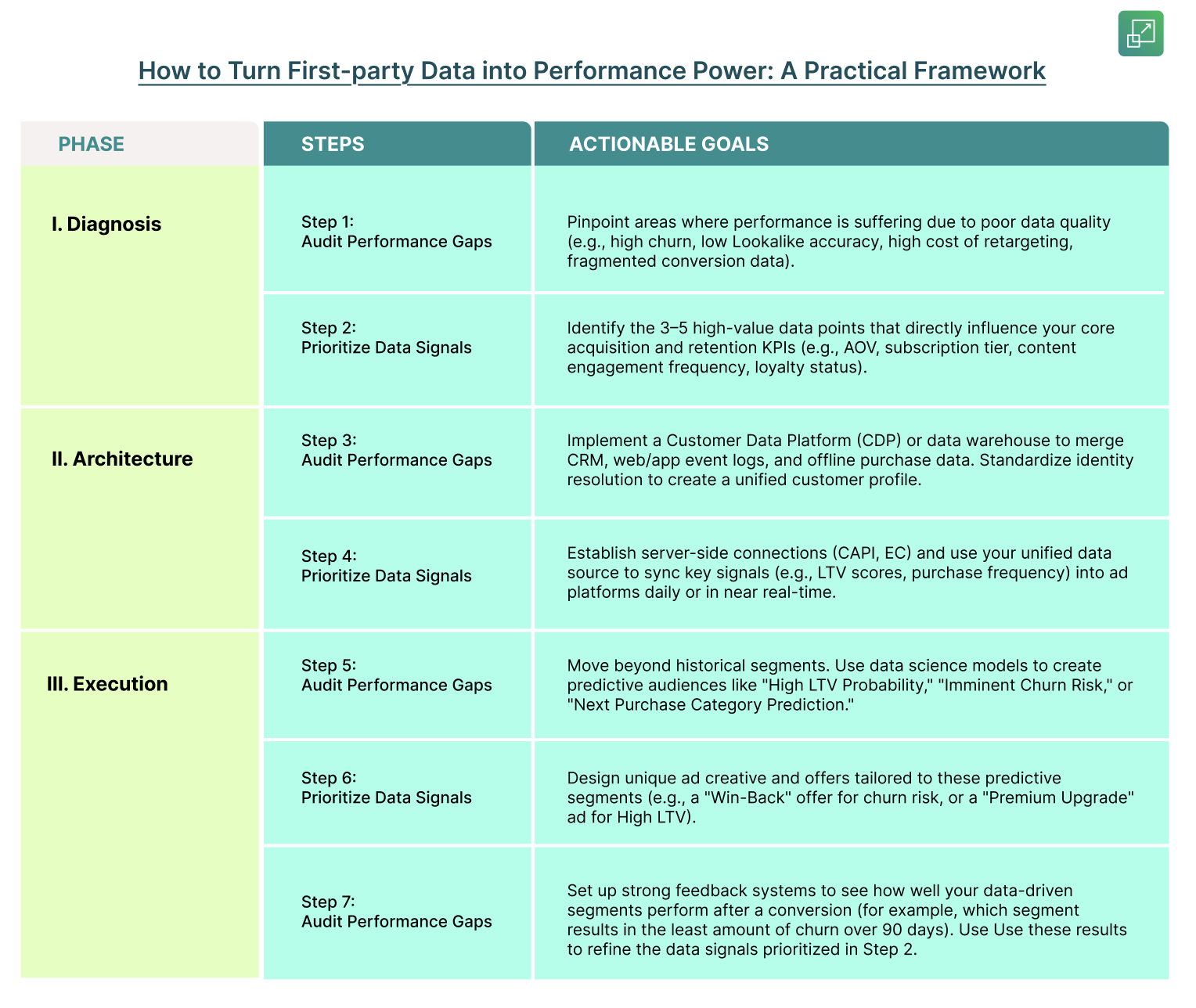 The process is a continuous loop where intelligence gained from outcomes feeds back to refine the input signals, ensuring perpetual optimization. This framework transforms first-party data from a static asset into the most dynamic, potent engine in your entire performance marketing strategy.
The ultimate takeaway? Your data is your greatest strategic advantage; treating it as such is non-negotiable for future growth.
Common Mistakes Brands Make (Even When They Have First-Party Data)
Having a first-party data asset is a prerequisite for success, but it is not a guarantee. Many brands invest heavily in collection technology only to fail in execution. The difference between success and stagnation often lies in avoiding these common, yet critical, strategic errors:
-
Collecting Data But Not Activating It: The most common failure is treating a Customer Data Platform (CDP) or data warehouse as a sophisticated storage unit. Data only generates value when it is actively moved, synced, and used to inform real-time campaign decisions. If your segments sit idle, the investment is wasted.
-
Focusing on Volume Instead of Quality Signals: Brands often obsess over the sheer size of their first-party database. However, a small, highly qualified segment of Top 5% LTV customers is infinitely more valuable for algorithmic learning than a massive, low-value “All Registered Users” list. Prioritize the depth and richness of your signals over the breadth of your audience volume.
-
One-Off Uploads Instead of Automated Syncs: Relying on manual, weekly, or monthly CSV uploads to refresh audience segments is a recipe for poor performance. Performance marketing thrives on speed; automated, near-real-time synchronization via server-side APIs (like CAPI) ensures that your algorithms are always optimizing against the freshest customer intent, maximizing your match rate and minimizing wasted spend.
-
Not Aligning Creative Strategy with Audience Insights: Data-driven segmentation is useless if the creative a user sees is generic. If you identify a “Churn Risk” segment, the ad should feature a compelling win-back offer or a message focused on renewed value. If you target a “High-LTV” segment, the creative should speak to exclusivity or loyalty—the data must inform the message.
-
Overdependence on Platform Automation Without Audience Intelligence: Ad platform automation (like Google PMax or Meta Advantage+) is powerful, but it functions best with minimal, high-quality inputs. The mistake is feeding it generic data and expecting brilliance. Your proprietary first-party intelligence is what gives you control and a competitive edge; it guides the black box, rather than letting it blindly guide you.
The Future of Performance Marketing: Will it be Data-Led?
As we look toward 2026 and beyond, the gap between “data-rich” and “data-poor” brands will become an unbridgeable chasm. The evolution of performance marketing is moving toward a highly automated, yet deeply proprietary, ecosystem.
-
The Growth of Data Clean Rooms: Technologies like Google Ads Data Hub (ADH), Amazon Marketing Cloud (AMC), and Meta Advanced Analytics will become standard. These privacy-safe environments allow brands to join their first-party data with platform-level data, unlocking deeper attribution and journey mapping without compromising user privacy.
-
Predictive AI as the Standard Input: We are moving away from reactive reporting. The future belongs to AI models that predict intent, content preference, churn, and LTV before the customer acts. These predictions will be fed directly into platform APIs to guide automated bidding with surgical precision.
-
The Organizational Competitive Moat: First-party data is transcending the marketing department. It is becoming an organizational moat that informs product development, supply chain optimization, and pricing strategies.
-
The Winning Formula: Success will no longer be determined by who has the best media buyer, but by the synergy of platform performance algorithms and brand-owned signals.
Concluding Thoughts
Modern performance marketing depends entirely on the quality, depth, and real-time activation of your owned data. Feeding “black-box” algorithms generic signals is a recipe for rising CAC and shrinking margins. To gain a true competitive advantage, you must move beyond passive data collection toward a model of continuous, automated, and insight-driven activation.
The gap is widening. The infrastructure you build today—the server-side connections, the predictive models, and the unified customer views—will determine your ability to scale tomorrow.
Build your data-backed performance engine now. The future of your growth depends on it.