


Digital ad spend continues to rise, but so does wastage. Marketers are losing 25–30% of impressions to bots and fake traffic, with influencer campaigns seeing inflated reach of up to 80%. The core issue lies in unreliable, third-party data.
With cookies fading and client-side tracking eroding under browser restrictions, ad blockers, and privacy laws, attribution has become increasingly unreliable.

To survive in this privacy-first era, marketers must shift from depending on external, flawed data to leveraging consented, first-party data that restores accuracy, improves targeting, and makes every ad dollar count.
Chapter 01: The Cookie Crumbles – Why Your Ads Are Flying Blind?
The shift in customer expectations is a significant indicator of how companies must address the declining use of cookies and transition to consent-based advertising. Your users have come past the time when personalization was appreciated; now it is a given. Users want brands to understand their habits and needs, and offer solutions that are tangible and aligned with their needs, all of this even before they ask. The current trend is hyper-personalization.
Challenge? Brands are struggling to cope with inaccurate data due to the demise of third-party cookies. What once powered your digital advertising is now declared obsolete. Building solutions and offering services to consumers who are skeptical of sharing personal details is no easy feat, unless brands understand this shift inside-out.
This shift isn’t just a looming threat; it’s already reshaping how ads perform, how audiences are built, and how conversions are measured. It’s not theoretical. It’s happening now.
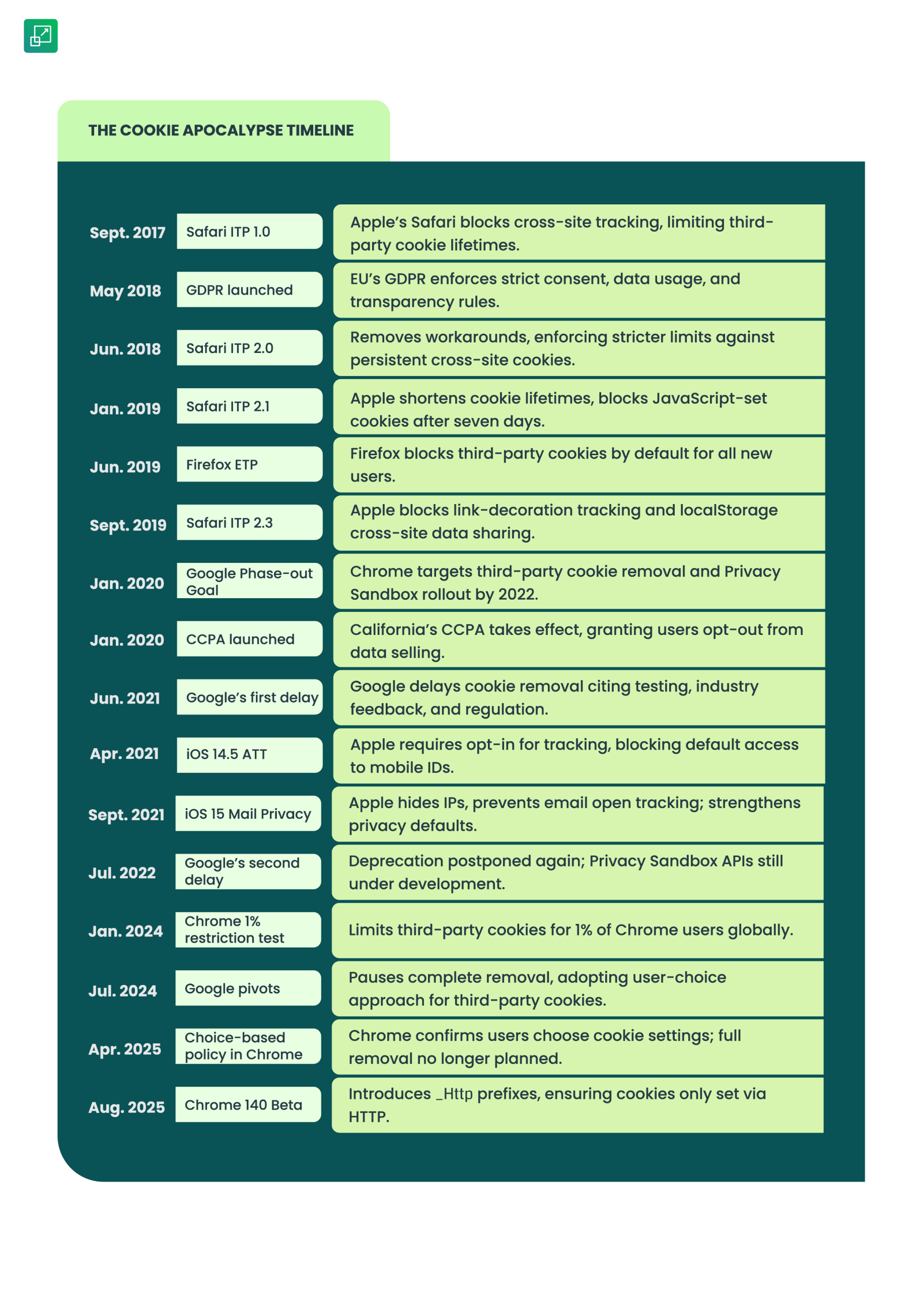
Despite the delays, the writing is on the wall. Chrome may be last to act, but together, Safari, Firefox, Edge, and ad blockers already account for more than 45% of global internet traffic. That’s nearly half the web slipping through the cracks of cookie-based attribution.
1.1. Why Native Tracking is Losing Its Grip?
Native tracking methods like Meta Pixel and Google Ads tags are rapidly losing effectiveness in a cookieless, privacy-first world. These client-side scripts depend on browser execution, which is increasingly disrupted by ad blockers, privacy regulations, and the decline of third-party identifiers. Even when pixels load, meaningful data often isn’t collected without explicit user consent, leaving large portions of traffic unmeasured. The technical limitations are equally damaging—without cookies, pixels can’t connect user journeys across sessions or devices, fragmenting what was once a clear attribution path.
1.2. The Missing Puzzles: Attributions and Signals
Modern marketing is becoming a guessing game as third-party tracking collapses, leaving critical insights missing. Conversions, session times, referral sources, device types, and user intent are increasingly hidden behind blocked scripts, anonymized traffic, and stricter consent rules. This fragmented data doesn’t just hurt analytics—it cascades across the funnel. For example, lookalike audience quality deteriorates when seed data is incomplete, causing platforms like Meta to find less relevant users. Without reliable tracking signals, marketing teams face the equivalent of trying to solve a puzzle with missing pieces.
1.3. The Business Impact: Less Signal, More Waste
The greatest danger of signal loss isn’t just missing insights—it’s wasted ad spend. Campaigns continue to run, impressions are served, and clicks roll in, but with broken tracking, conversions are underreported, audiences shrink, and algorithms lose the feedback they need to optimize. This creates a vicious cycle: retargeting pools weaken, prospecting wastes impressions on irrelevant users, and acquisition costs rise while conversions stagnate. With less data feeding ad platforms, every optimization decision carries more risk. Marketers end up paying more for less, eroding ROI and straining budgets.
Chapter 02: The Leaky Bucket – Why Your Client-Side Attribution Is Failing?
Client-side tracking has long been the standard for digital marketers, but it’s now failing in today’s privacy-first environment. Modern browsers like Safari (ITP) and Firefox (ETP) block or limit tracking scripts, while ad blockers strip them entirely—impacting nearly 40% of internet users, especially those in valuable demographics. On top of that, GDPR and similar regulations mean pixels often require explicit consent to fire, leaving large gaps in data.
The result is a fragmented and incomplete view of performance, where marketers can’t reliably see who clicked, converted, or which channel drove results. Beyond missing data, the sheer number of scripts loaded through tools like Google Tag Manager slows page speed, harming SEO, user experience, and ultimately conversions.
Google research shows bounce rates jump 32% when load time increases from one to three seconds, and by 90% when it hits five. This means every additional client-side tag not only risks underreporting results but also directly drives users away.
Despite these flaws, marketers still lean on client-side tracking because it’s familiar and easy—until the cracks become too big to ignore, eroding both performance and ROI.
Evolving Users’ Perspectives
Users are increasingly skeptical of how their data is collected and used. Third-party scripts running silently in the background make advertising feel invasive rather than helpful. Cookie banners, retargeted ads, and unclear opt-outs only reinforce this sense of surveillance. The result is a widening trust gap—where even well-meaning brands are seen as intrusive.

For marketers, signal loss translates into wasted spend. When conversions aren’t tracked, ad platforms like Google and Meta lose the feedback loops they need to optimize. Campaigns degrade, budgets are misallocated, and audience pools shrink. Studies suggest broken attribution alone can cut ROAS by up to 40%.
In one common scenario, Google Ads underreports conversions by 30% due to blocked tracking. Its algorithm assumes poor performance, reduces bidding, and impressions decline—despite healthy conversions in the CRM. This isn’t rare; it’s the everyday reality of client-side tracking. Without fixing these leaks, marketers are paying more for less, making growth targets harder to reach.
Chapter 03: Server-side Tracking – Going Beyond the Browser
Server-side tracking is emerging as a durable alternative to failing client-side methods. Instead of relying on browser-based pixels—often blocked by ITP, ETP, ad blockers, or consent frameworks—it shifts tracking logic to secure servers.
This approach gives marketers complete control over data collection, consent management, and the quality of signals sent to platforms like Meta and Google. Beyond surviving cookie loss, it enables building a compliant, reliable, and future-ready data infrastructure.
By owning the tracking layer, brands reduce data loss, restore attribution accuracy, and improve campaign performance in today’s fragmented ecosystem, ensuring every ad dollar works harder and smarter.

Why Server-Side Means Better ROI?
When ad platforms can see clean, consented events delivered directly from your server, they can optimize effectively. Campaigns improve because the data feedback loop is restored. Lookalike audiences improve because the seed data is more complete. Attribution becomes real again. Customer acquisition costs decrease because targeting is based on actual behavior, not modeled guesswork.
Reading Resource: How to Set Up Server-side Tracking: A Step-by-Step Guide
Chapter 04: First-Party Data & Server-Side Tagging – The Game Changer
The combination of first-party data and server-side tagging offers marketers something the old systems never could: privacy-aligned, high-performance campaigns built on trust, precision, and control.
This is the new blueprint for marketing in a cookieless world.
Reading Resource: Low CAC, High ROAS: Unlock the First-party Data Advantage
Download the ebook to read more on server-side tagging with first-party data. Insights inside:
- What is Cookieless Tracking (First-Party Data)?
- Why first-Party + Server-Side?

Chapter 05: Setting Up Server-side Tracking: A Practical Guide
The increasing limitations of client-side tracking, like data loss from ad blockers and browser Intelligent Tracking Prevention (ITP), create performance bottlenecks and accuracy issues for marketing ads. In fact, at least 30%-60% of data loss occurs due to denied cookie consent, directly impacting analytics and advertising effectiveness.
The bottom line is that this unreliable client-side approach no longer meets the stringent demands of modern data-driven marketing.

What will you get inside the ebook?

-
- Understand the Web + Server-side GTM Architecture.
- Why not use GA4 with Google Ads.
- Core components of server-side implementation.
- Setting up server-side tracking: Phase-by-phase guidance.
- Implementation using Google Tag Manager: Technical guide.
- Prerequisites
- Step-by-step guide
-
Chapter 06: Compliance and Security
The shift to first-party data and server-side tagging goes beyond ad performance—it’s about building trust, compliance, and control in a privacy-first era. Unlike client-side tracking, server-side models let brands decide what data to collect, why it’s collected, and how it’s secured. This empowers companies to honor user rights, reduce dependency on risky third parties, and strengthen accountability. With laws like GDPR, CCPA, and India’s DPDP tightening, brands that adopt privacy-by-design infrastructure are positioned to earn customer trust and stay ahead of regulatory demands. More importantly, server-side tagging future-proofs marketing, ensuring adaptability as browsers and laws evolve.
5 Key Benefits of Server-Side Tagging:
- Enhanced Data Control & Governance – Secure handling, anonymization, and purpose-bound data collection.
- Robust Consent Management – Centralized, enforceable compliance with GDPR, CCPA/CPRA, and DPDP.
- Reduced Reliance on Third Parties – Minimized risk of leaks, blocks, or compliance violations.
- Fortified Security & Accountability – Encrypted, monitored data with clear audit trails.
- Future-Proofing – Agile infrastructure to adapt to new laws, browser changes, and cookie deprecation.
Chapter 07: Quick Wins for Marketers
Rebuilding your data stack doesn’t have to feel overwhelming. With the right priorities, marketers can quickly recover lost performance and build a durable, privacy-first foundation. From auditing tags to enforcing consent and unifying analytics, small changes compound into big wins—restoring accurate attribution, stronger targeting, and higher ROAS.
5 Quick Wins for Marketers with First-Party Data:
- Audit & Fix Tags – Identify leaks, duplicates, and consent gaps in client-side tracking.
- Track Key Conversions – Focus on purchase events, trial activations, and subscriptions that drive revenue.
- Send Secure IDs – Pass gclid, fbclid, and hashed emails via ScaleX360 for improved attribution and audience matching.
- Enforce Consent in sGTM – Let only opted-in data flow, making privacy part of your architecture.
- Unify Analytics – Combine GA4, CRM, and ScaleX360 to build a complete, cross-channel customer view.

Privacy by design isn’t optional—it’s the new path to trust and growth.
Fix your signals. Scale what works. Trust ScaleX360 to turn first-party data into your competitive edge.Chapter 08: ScaleX360 for Industry-wide Adoption
Forward-looking brands are no longer experimenting—they’re executing. With ScaleX360’s server-side tracking infrastructure, companies across industries are regaining signal clarity, lowering acquisition costs, and improving campaign precision. Here’s how first-party data and server-side tagging are turning strategy into ROI.
At its core, Scaletrix’s mission is simple: to help global brands easily launch secure data pipelines, collect rich user signals responsibly, and stay compliant with data laws such as GDPR, CCPA, and DPDP. With ScaleX360, you get:

Ready to change how your business collects user data? Get our ebook as a handy guide. For immediate transition to first-party data tracking, get in touch with us.
-